

Global
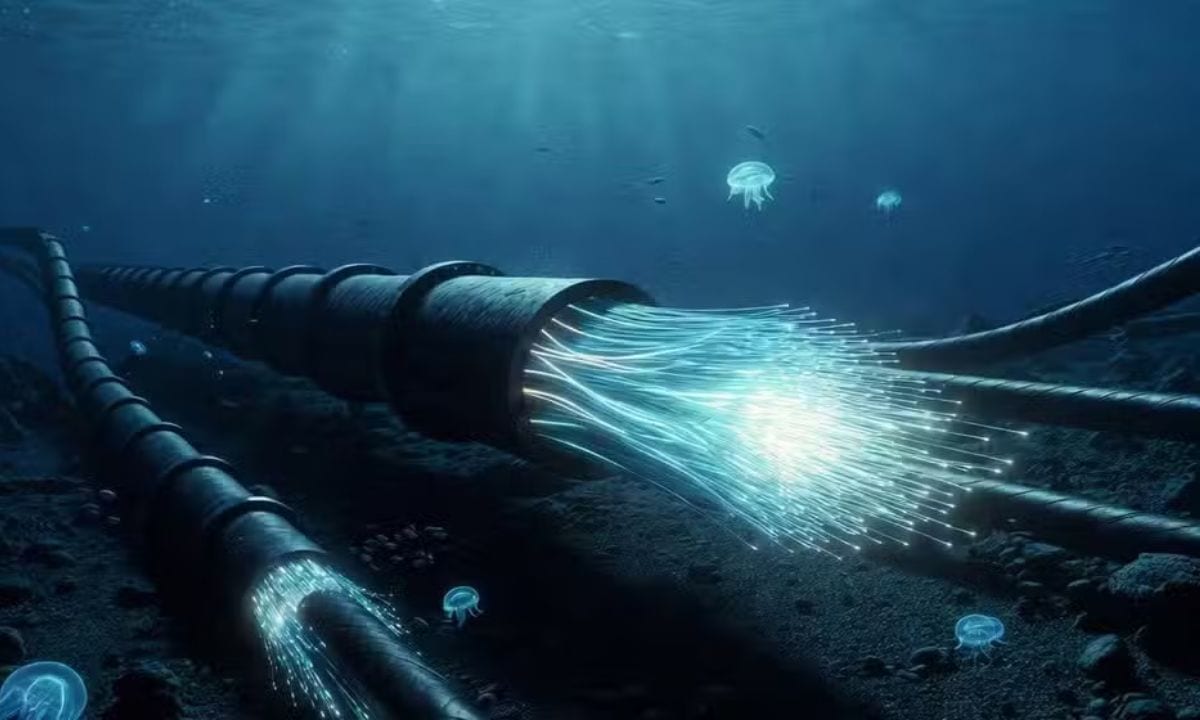
The Iranian "Fars" agency said in its report titled: "A $10 trillion treasure at the bottom of the Strait of Hormuz," that all fiber optic cables at the bottom of the Strait will be under absolute Iranian sovereignty.
The report stated that after Iran restored its full management over the Strait of Hormuz in implementation of its sovereign rights in its territorial waters, a new legal and technical issue arises: the legitimacy of Iran imposing its sovereignty over fiber optic cables passing through the bed of this vital corridor and beneath its surface.
According to "Fars", pursuant to the 1982 United Nations Convention on the Law of the Sea, Iran enjoys full sovereign rights over the seabed and its subsoil within a distance of 12 nautical miles from its coast, and given that the width of the Strait of Hormuz does not exceed 21 miles, the entire waters of the Strait, its bed, and its airspace fall within the territorial waters of Iran and the Sultanate of Oman, and there is not a single centimeter of free waters or an exclusive economic zone in the Strait of Hormuz. Therefore, the legal team in Iran believes that the fixed cables passing through the bed of the Strait of Hormuz do not fall within the concept of "transit passage" designated for ships and aircraft, but rather represent a permanent use of the seabed subject to Iranian permits and control.
According to this interpretation, it is assumed that every kilometer of international internet cables (Google, Microsoft, Amazon, Meta, etc.) extending at the bottom of the Strait of Hormuz may require an Iranian license, and become subject to technical and security control and the payment of sovereign fees, similar to what other countries do with cross-border technological infrastructure. Iranian legal approaches also encourage considering the imposition of additional fees for services such as navigation safety, protection of the marine environment, and linking foreign maintenance companies with local workers under the umbrella of its sovereignty.
In practical terms, the analysis published by "Fars" agency in its report under the title: "A $10 trillion treasure at the bottom of the Strait of Hormuz," indicates that Iran, as the coastal state managing the Strait of Hormuz, can treat submarine cables as it treats any property affecting its sovereignty, turning this digital infrastructure into a strategic tool for economic and international negotiation, with the confirmation that any continuation of the operation of these cables requires the approval of the Iranian government and the signing of cooperation and maintenance agreements within its regulatory rules.