

Technology
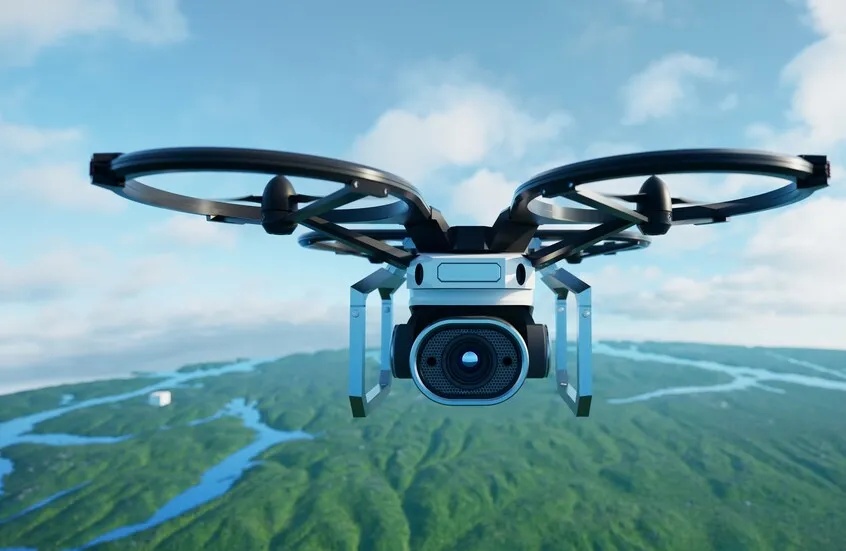
Northwestern University has witnessed the invention of a groundbreaking drone, paving the way for a new generation of aerial vehicles difficult to spot with the naked eye. The drone, dubbed "PhantomTwist" by researchers, employs an innovative principle distinct from traditional camouflage techniques, based on rotating its entire body at an incredibly high speed of up to 25 revolutions per second. This velocity exceeds the human eye's ability to discern its intricate details. While not entirely invisible, tests have shown it to be approximately ten times less noticeable compared to commonly used quadcopter drones. Researcher Michael Rubenstein, leader of the team, explains that most previous attempts to conceal drones focused on blending them with their surroundings. In contrast, his team adopted a completely different approach, designing the aircraft to align with how the human eye perceives motion. Its continuous rotation blurs its visual features and disrupts its clear visibility. To achieve this, researchers embarked on an intensive design process, generating nearly 20,000 different designs using computers. They then utilized artificial intelligence to test hundreds of possible component arrangements, ultimately arriving at the final design that met performance and flight capability requirements. The "PhantomTwist" design radically differs from conventional drones. Instead of relying on four engines and four propellers, it uses a single engine and a single propeller, while its entire body rotates during flight. This mechanism prevents the presence of fixed parts that the human eye could easily capture and identify. Rubenstein clarifies that traditional drones keep their body stable while only the propellers rotate, making them clearly visible. In the new design, the entire body's rotation causes its details to visually merge with the background, making the drone appear as a blurry or "ghostly" patch, according to the research team's description. Co-researcher Emma Alexander adds that the human eye requires a fraction of a second to form a clear image. When an object moves very quickly, its details become blurred and indistinct. Because the innovative drone is mostly made of transparent materials, its few opaque parts visually blend with the background, further increasing the difficulty of observing and spotting it. Despite the promising results, the drone still faces some limitations. Its wires and support rods remain visible, and it emits a high level of noise during operation. These factors could restrict its use in certain missions requiring complete acoustic or visual stealth. Researchers hope that this technology will contribute in the future to the development of drones that can be used for wildlife monitoring, conducting precise environmental surveys, and inspecting critical infrastructure, all while reducing the visual clutter caused by conventional drones. Conversely, other experts point out that the design still faces technical challenges. Peter Lee, a researcher at the University of Portsmouth, believes that adding any new sensors or equipment to the drone would increase its visibility and make it easier to detect. Furthermore, any increase in weight would negatively impact its balance and centrifugal forces, potentially hindering its efficient flight capability. He also explained that this type of drone is less maneuverable compared to quadcopters, as banking at sharp angles slows down its rotation, making it more visible and potentially affecting its stability and performance during flight.