
policy
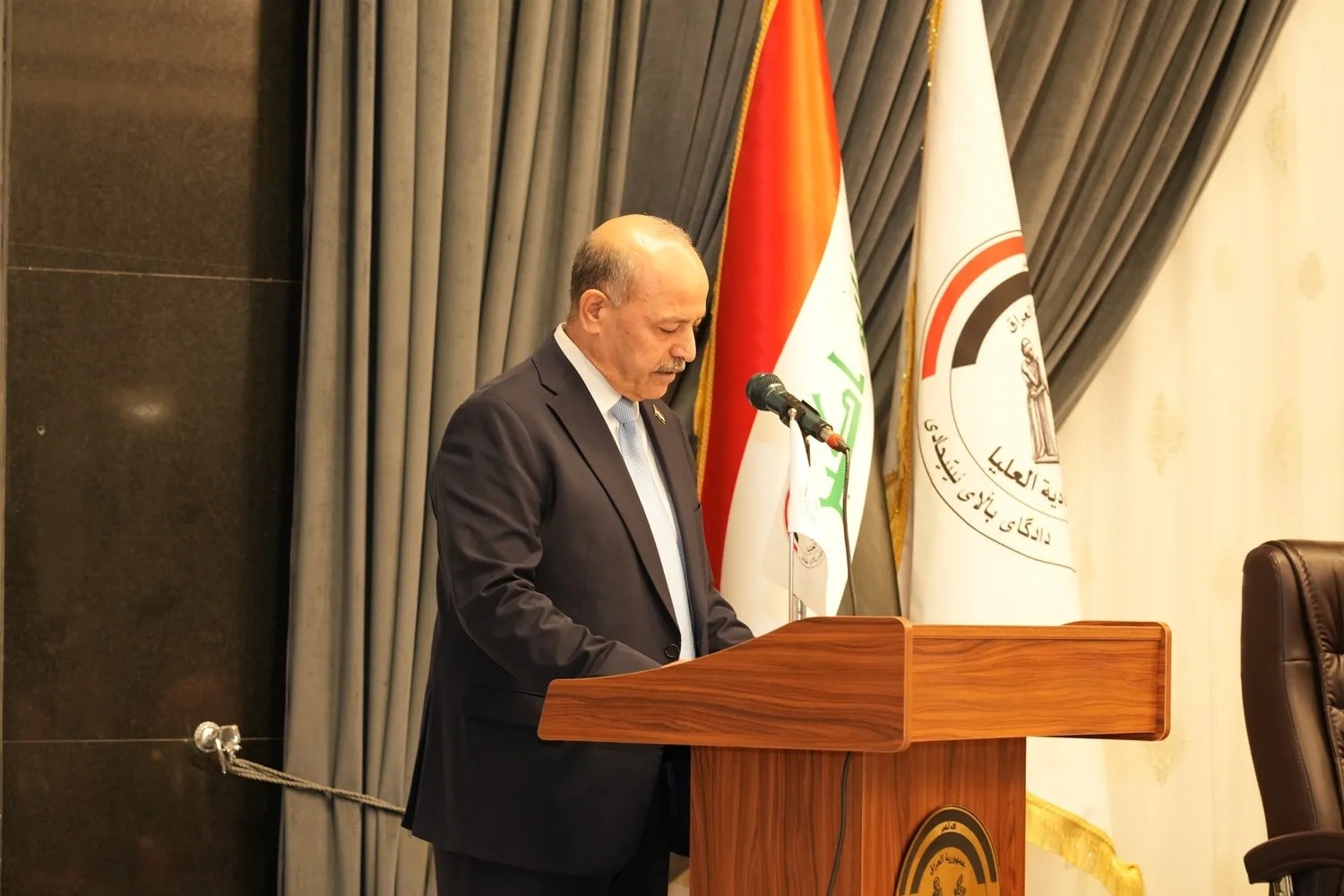
The President of the Federal Supreme Court, Judge Munther Ibrahim Hussein, affirmed on Sunday that discussing sovereignty cannot be separated from the judiciary and its independence, stating that there is no sovereignty for a state where the law is not respected, no law is feared without an independent judiciary, and no judiciary without faith. During a speech at a celebration marking Sovereignty Day, Judge Munther Ibrahim Hussein stated that national sovereignty is one of the highest pillars upon which the modern state rests, and it is not limited to being written in constitutional texts alone. He continued that sovereignty is the people's will and demand to attain freedom and independence, their ability to stabilize decision-making, enforce laws, and build institutions, granting the people a dignified life that befits their history, present, and future aspirations. He pointed out that sovereignty, with its national and ethical dimension and its responsibility that extends beyond geographical borders, fundamentally encompasses the state's ability and potential to safeguard rights, dignity, and justice. The court president emphasized that discussing sovereignty cannot be isolated from the judiciary and its independence, reiterating that there is no sovereignty for a state without respect for the law, no formidable law without an independent judiciary, and no judiciary without faith that carries the message of justice with courage and boldness. He explained that the essence of a constitutional state lies in the compliance of the legislative, executive, and judicial authorities with the constitution in all their practices, especially since constitutional judiciary represents the guarantee confirming the link between sovereignty, the state, and the citizen. He noted that constitutional oversight over legislation is not limited to organizing relations between authorities, but extends to protecting citizen rights from any legislation conflicting with rights and freedoms guaranteed by the constitution. He stressed that the role played by the constitutional judiciary is evident in protecting the federal structure of the state and preventing institutional overlap, which indicates that sovereignty in a constitutional state is closely tied to state legitimacy, a legitimacy that can only be sustained through respect for humanity and the law governing life affairs. The court president continued that celebrating Sovereignty Day affirms all the connotations that forged the noble meanings for establishing the state across various orientations and consensuses. He added that this occasion gains its value from the ability to renew awareness of the national principles deeply rooted in individuals' consciences, which include state sovereignty, national unity, respect for the constitution, judicial independence, protection of rights, and honoring martyrs, emphasizing that the state could not have risen without the sacrifices of martyrs and wounded patriots. He stated that martyrs and wounded personnel are the nation's memory, present, and future light, noting that the martyr who sacrificed himself to protect state security, safety, and independence is the very one who protected its justice and the sovereignty of its law, as both contribute from their positions to protecting the state and its components, making loyalty to them the strongest catalyst for instilling citizenship and bravely defending the homeland and its capabilities.