
Technology
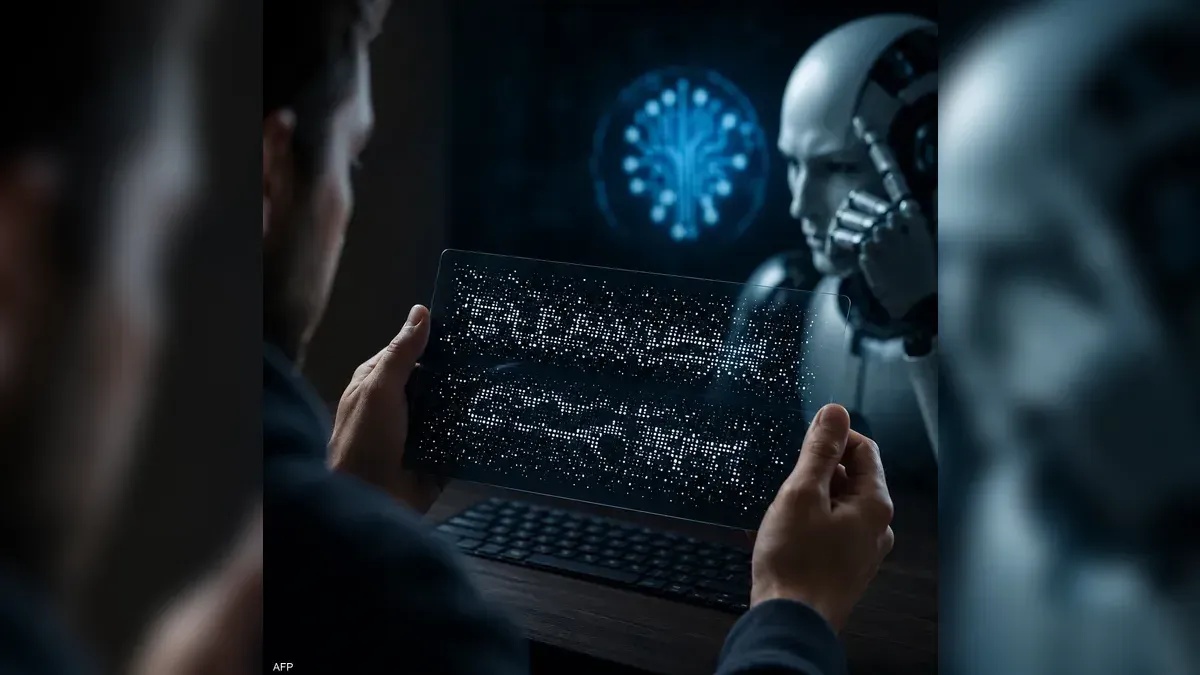
Scientists have successfully developed a new typeface, dubbed "Ghost Font," designed to resist artificial intelligence systems. This innovation relies on motion to form messages, allowing humans to read them clearly, while even the most advanced AI models find significant difficulty in deciphering them easily. This invention emerges amidst the growing presence of artificial intelligence in various aspects of daily life, from wearable devices to communication applications, raising increasing questions and concerns about message privacy and the potential for smart systems to access them. Eric Lo, the font's developer, explained that "Ghost Font" is based on a unique integration of motion, video, noise, and decoy messages, aiming to provide a distinctive written communication method between individuals. He clarified that this font is not a traditional typeface like (TTF) fonts, but rather a pioneering attempt to create a new visual method for written communication designed to be impenetrable to artificial intelligence. He noted that "although its readability is not as easy as regular texts, the human eye can distinguish its characters directly, while prominent AI systems face clear difficulty in deciphering them." To demonstrate its effectiveness, Lo tested the font using video clips on several of the most renowned AI models, and the results confirmed that even the latest of these systems encountered challenges in interpreting the dynamic message content. It is noteworthy that the project's concept was inspired by the ZXX font, designed by Sang Mun in 2013, which included four font styles crafted to be readable by humans but resistant to Optical Character Recognition (OCR) software. Lo stated that the ZXX font was then considered "surveillance-resistant," but advancements in AI technology now enable it to read texts written in it, which prompted him to shift to using motion instead of relying on fixed letter shapes for his new innovation. Those interested can experience "Ghost Font" through the developer's blog, where characters are formed by the movement of specific dots. When the video is paused, the message completely disappears due to the blending of static dots, rendering a screenshot ineffective for revealing its content. To enhance security, the developer embedded a decoy message within the video, leading AI systems to believe it is the actual message, while the original message remains concealed. He indicated that this trick allows the font to successfully hide messages, even from the most advanced AI thinking models, such as Fable and GPT Sol 5.6 Ultra. Lo believes that this innovation may transcend being merely a technical experiment, finding practical applications, particularly in strengthening CAPTCHA systems, which many AI models have become capable of bypassing. He clarified that integrating motion within video could make it extremely difficult for automated robots to decipher messages, while remaining relatively easy for humans. Nevertheless, the developer acknowledged the possibility that continuous advancement in artificial intelligence might enable the decryption of this font in the future as well. He stated: "Artificial intelligence has become highly advanced. Although 'Ghost Font' is difficult for AI to read, it is not entirely easy for humans either. The gap between the two parties continues to diminish." He added that future developments would reveal how the perceptual capabilities of artificial intelligence and multimodal models would evolve. This innovation has sparked widespread interaction across social media platforms. One user on "X" questioned: "Is this the perfect CAPTCHA system?" while another expressed belief that such efforts would only be effective for a limited period before AI systems overcome them, and a third user humorously remarked: "The only drawback is that it drives anyone who looks at it insane."