Global
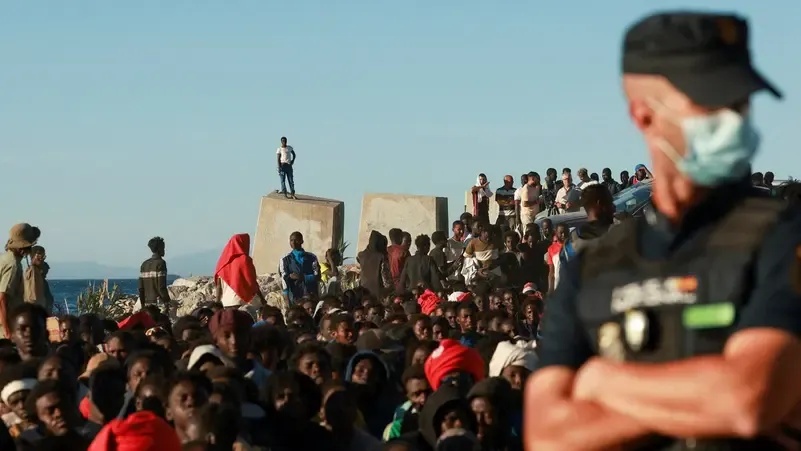
The unprecedented influx of migrants into the Spanish city of Ceuta has prompted European Union nations to unify their stance behind Madrid, undertaking swift actions to bolster the bloc's external border protection and prevent a recurrence of the large-scale mass crossings recently witnessed in Europe. France announced its readiness to support Spain in confronting the fallout from this mass influx, including potentially reinforcing the deployment of the European border agency "Frontex" should Madrid request it. French Interior Minister Laurent Nuñez affirmed, following an informal meeting of EU interior ministers chaired by Ireland on August 4, that member states unanimously expressed solidarity with Spain, commending the management of the crisis by Prime Minister Pedro Sánchez's government and the cooperation with Rabat which helped repatriate a significant number of migrants. He added that Paris is prepared to offer any support, noting that France had already deployed 334 additional personnel to its border with Spain following the crisis's outbreak. Nuñez also revealed that his Spanish counterpart, Fernando Grande-Marlaska, informed European ministers of 75 bodies found so far due to the mass influx into Ceuta, emphasizing that the toll is preliminary and could rise. He stressed that none of the migrants who entered Ceuta during the crisis reached the European mainland, and that the Schengen area is "part of the solution" given the city's special control measures for transit to EU territory. He explained that Spanish authorities erected a floating barrier to deter swimming attempts, adapting to a Supreme Court ruling that limited immediate maritime returns—a loophole exploited by human trafficking networks. European interior ministers condemned what they termed "informational interventions" by unnamed foreign states, exploiting crisis images to attack European migration policy and incite division. In a clear indication of shifting European positions, Denmark welcomed Spain's measures to contain the crisis, having previously hinted at the possibility of suspending cooperation with Madrid within the Schengen framework. Danish Minister for Immigration and Integration Morten Bødskov stated that the swift Spanish response, particularly the deployment of police and military forces and the repatriation of a large number of migrants to Morocco, was well-received, emphasizing that the events in Ceuta underscored the critical importance of maintaining control over the European Union's external borders. Despite Spanish authorities successfully returning approximately 69,500 migrants to Morocco in the past four days, local officials estimate between 3,000 and 5,000 migrants remain within Ceuta. Reception centers are facing unprecedented, near-collapse pressure, while the city is caring for 862 minors who enjoy special legal protection against deportation. Hundreds have also established camps on one of the city's beaches amidst shortages of food and shelter. Footage showed dozens of migrants, mostly from sub-Saharan Africa, resting on the sands of "Trampoline" beach. Spanish Foreign Minister José Manuel Albares urged his European partners to demonstrate solidarity, affirming that cooperation with Morocco significantly aided the return of most individuals who crossed the border. Parallel to the field operations, Italy pushed for a tightening of European migration policy. Interior Minister Matteo Piantedosi called for the establishment of EU-funded migrant registration and return centers within safe third countries. He asserted that the bloc is now required to prevent crises from originating at their source and to return those who do not have the right to remain, rather than merely reacting to them once they reach its borders. The Ceuta crisis represents the first practical test for the new European Migration Pact, which came into effect last June after years of negotiations, raising questions about the new rules' capacity and solidarity mechanisms to handle sudden, large-scale influxes. The crisis also stirred political tensions, with Spain accusing some partners of unhelpful reactions. Greek Prime Minister Kyriakos Mitsotakis called for a European emergency mechanism to accelerate procedures, allowing, in exceptional circumstances, the temporary suspension of asylum application registrations during sudden mass arrivals, considering current rules designed for routine pressures, not coordinated flows. European Commissioner for Internal Affairs and Migration, Magnus Brunner, indicated that the events in Ceuta demonstrated some parties' willingness to use migration to test the European Union. However, he affirmed that Europe managed to control the situation and execute swift returns. European authorities also cautioned against the political exploitation of the migration issue, following interior ministers' condemnation of foreign "informational interventions" that used crisis images to attack European migration policy and incite division. Moroccan authorities, for their part, attributed the influx to misleading information on social media, human trafficking networks, and a misinterpretation of a Spanish judicial ruling concerning the return of migrants intercepted at sea. Amidst the debate over the sudden influx's causes, Spanish intelligence agencies are under scrutiny. Media reports indicated that security services concluded Morocco did not plan the mass crossing but permitted it, noting that Moroccan border control measures were gradually relaxed during July and then completely disappeared as crowds moved towards the Tarajal crossing during Morocco's Throne Day holiday. The Spanish Interior Minister had clarified that the Spanish National Intelligence Center (CNI) did not warn him of an imminent influx of this scale, causing tension with the Defense Ministry, whose minister declined to disclose prior intelligence, emphasizing its confidential nature. The crisis brought the migration file back to the forefront of European disputes after Italy temporarily suspended travel arrangements with Spain within the Schengen area for a month, despite these arrangements not applying to Ceuta. Furthermore, 22 out of 27 states demanded coordinated measures to reinforce the EU's external border protection. Commissioner Magnus Brunner reiterated that the events in Ceuta showed some parties' readiness to test the European Union's cohesion, but member states successfully contained the situation and implemented rapid migrant returns thanks to the new European rules.