

Technology
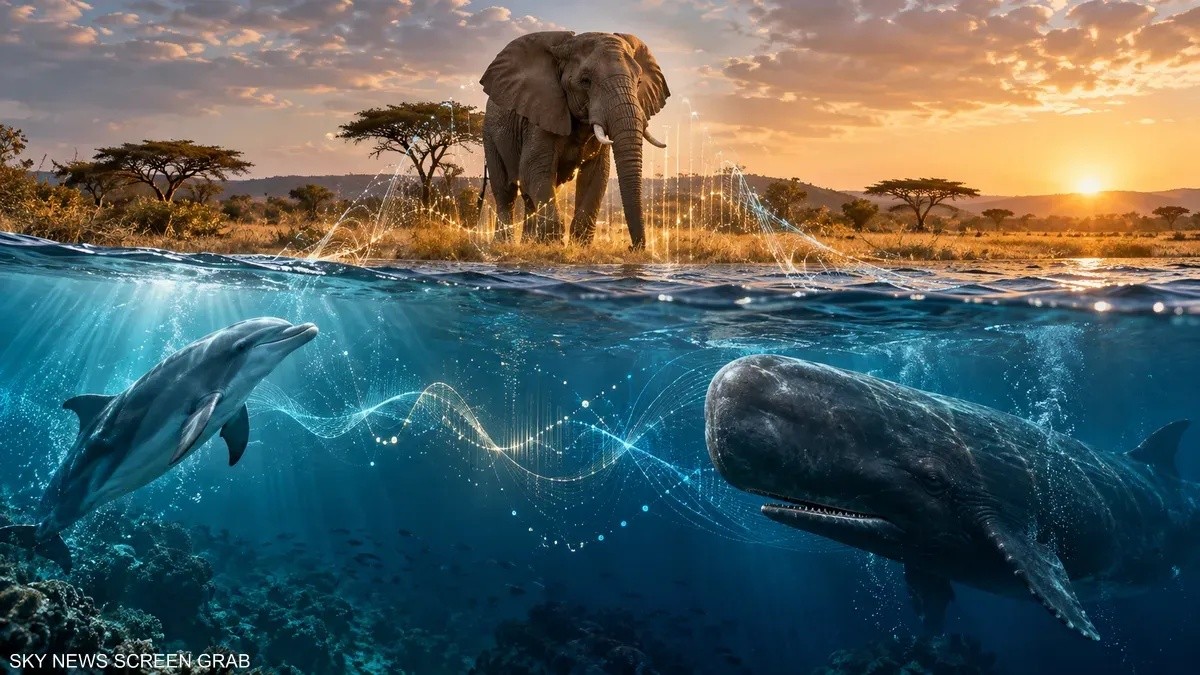
Artificial intelligence (AI) exhibits a growing capacity to detect subtle patterns within animal sounds, such as those of dolphins, elephants, and whales. However, it has not yet reached the stage of full translation that reveals their thoughts or converts their communication into human language. The main challenges lie in the significant scientific gap between merely recognizing a sound and truly comprehending its actual meaning. An AI model might identify a repeated call when an animal approaches or danger appears, yet this is insufficient to confirm that the call genuinely means "approach" or "danger" in a human-understandable sense. This discrepancy raises a deeper question, extending beyond technological capabilities: Is AI genuinely nearing an understanding of animals, or is it merely presenting compelling patterns that could lead us to misinterpretations? Among the pioneering projects in this field is "Dolphin Gema," developed by Google in collaboration with the Wild Dolphin Project and the Georgia Institute of Technology. The model was trained on a vast database of dolphin recordings, enabling it to analyze sounds, detect repetitive sequences, predict the next sound, and even generate sounds mimicking their calls. Nevertheless, these capabilities do not imply that the model understands the intended meaning of those sounds. Its ability to predict the next sound is akin to language models predicting the next word in a sentence, which alone does not prove comprehension of the animal's experience or what it wishes to express. Scientific teams hope these tools will help connect sounds with animal behavior and context, as a first step towards building a limited, shared vocabulary between humans and dolphins, although the project does not claim to possess an instant translator for dolphin language. In a related development, a study published in the journal "Nature Ecology & Evolution" indicated that African savanna elephants might use individual calls, similar to names, when addressing specific members of their herd. Researchers utilized machine learning techniques to analyze these calls, then conducted experiments involving playing back the elephant recordings. The results showed that an elephant responded more strongly to a call directed at it compared to calls intended for other individuals. These findings provide striking evidence for the presence of identity-specific information within some calls, yet they do not mean scientists are now capable of translating complete elephant conversations or deciphering all the messages contained within them. For sperm whales, researchers within Project CETI analyzed thousands of short clicks these whales use for communication. The analyses revealed organized changes in rhythm, speed, number of clicks, and vocal embellishments. A study published in "Nature Communications" found that these elements could combine in various ways, suggesting that whale calls possess a more complex structure than previously understood. Despite this, the researchers themselves confirmed they do not yet know the true meaning of what the whales are saying. Discovering an alphabet-like structure does not automatically equate to knowing the words or concepts being conveyed. A significant risk is that of illusory translation, where AI might discover a correlation between a specific sound and behavior, but this correlation may not represent the true meaning of the call. The sound could be influenced by factors such as the animal's identity, age, emotional state, or surrounding environment, rather than a single translatable message. Furthermore, animal communication does not rely solely on sound; it often includes movement, touch, scents, body posture, and visual cues. Therefore, analyzing sound recordings in isolation from these elements may lead to incomplete or misleading interpretations. These limitations do not signify a failure of AI; on the contrary, AI has granted scientists unprecedented ability to sort recordings and detect patterns that are difficult for humans to notice. The machine can now hear details we previously could not perceive, but it remains far from proving it understands them. Until then, the "animal translator" remains an exciting scientific promise, not a tangible reality.